Hotel Key Card Kiosk Failure Recovery: Engineering and Acceptance Testing Guide
A practical engineering guide to the cases that occur after the first successful room-key test.
What must a hotel kiosk do when card issuance does not go as planned?
Hotel self-check-in projects often validate the happy path first: identify guest, encode card, present card. Production acceptance also needs clear handling of encoding failure, missing card, guest walk-away, interrupted power and ambiguous completion.
Design the transaction around observable states
| State | Required confirmation | Recovery question |
|---|---|---|
| Ready | Dispenser online, stock available, no unresolved card | What happens after a device reconnect? |
| Card positioned | Transport reports card at encoder position | Can the host safely retry positioning? |
| Encoding pending | Encoder request issued and result awaited | What is the timeout and retry limit? |
| Encoded | Lock system confirms writing/verification success | How is a failed card rejected? |
| Presented | Card moved to guest-accessible outlet | How is uncollected-card behavior configured? |
| Completed | Project-defined handover confirmation recorded | What if the guest reports no key? |
These are recommended application-level states, not a claim that every SNR module exposes identically named commands. Map them to the actual SDK and supported sensors.
Four failure scenarios worth testing before hotel rollout
01 — Encoder timeout
Hold the card at the writing position while the application checks whether the encoder operation completed. Never assume a timeout means the card is valid. Route unresolved cards according to the approved reject policy.
02 — Guest leaves without taking the card
Define a collection or retract policy only if the chosen module and configuration support it. Decide how the kiosk logs the event and whether another key may be issued.
03 — Power loss mid-transaction
After restart, reconcile the physical card position with the software transaction record before issuing another credential.
Choose hardware based on the recovery policy—not only card capacity
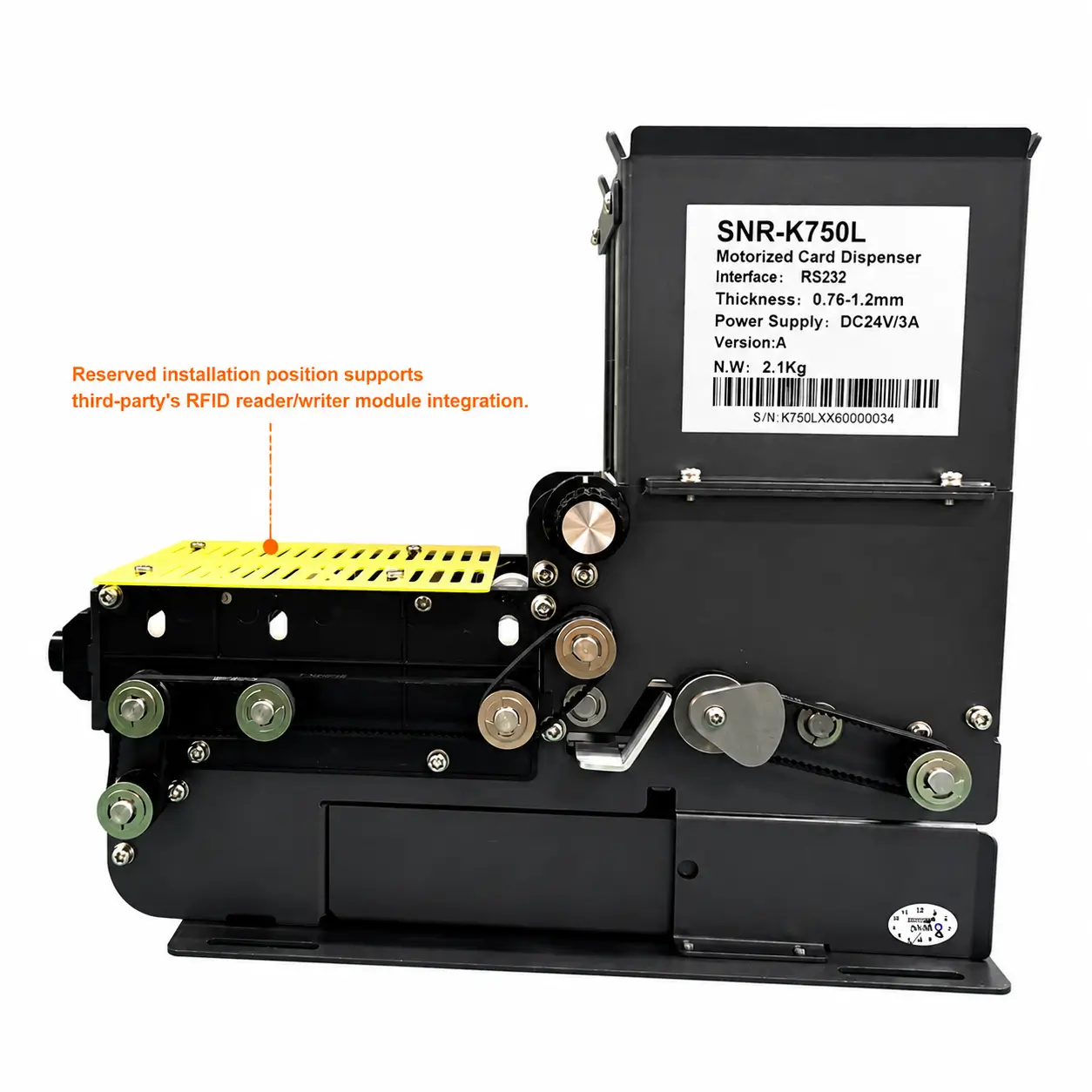
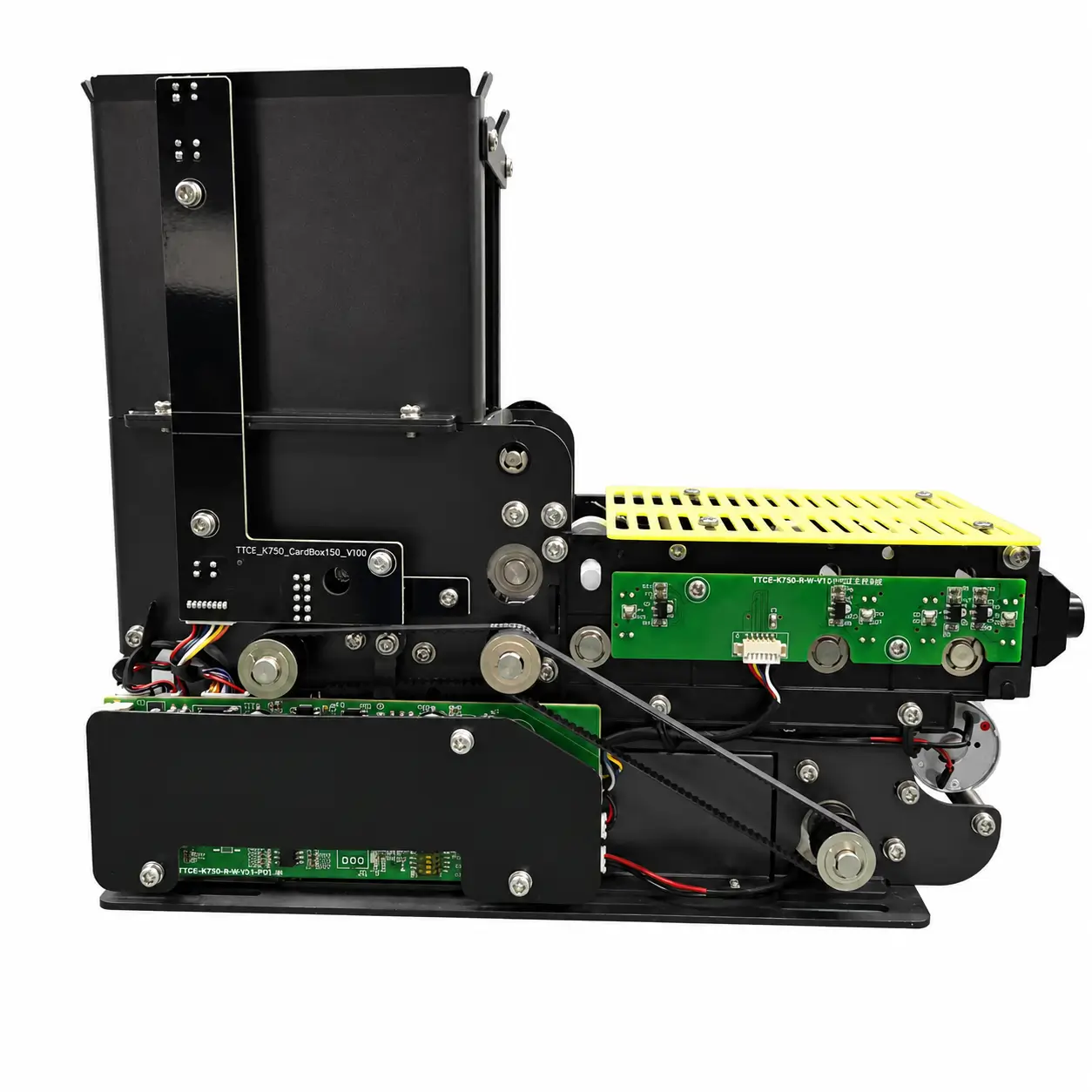
Reusable card loop: SNR-K750L
Appropriate when the hotel wants returned cards to be verified and fed back into circulation. The separate reject path matters when a returned credential is damaged or fails validation.
Collection without reuse: SNR-K750C. Suitable for projects requiring dispensing and reject-card collection without a recirculating inventory.
Desktop deployment: SNR-CD760. Available in recycling and non-recycling versions. Confirm the chosen version before specifying guest return behavior.
For the basic encoder mounting procedure, use the existing hotel door-lock encoder integration guide; this article focuses on operational acceptance.
Who owns each recovery decision?
| Party | Responsibility |
|---|---|
| SNROTEK | Card-handling hardware, device-level communication documentation, supported SDK, mechanical integration guidance |
| Kiosk manufacturer / integrator | Host state machine, retries, logs, timeout behavior, device monitoring and kiosk-level recovery |
| Hotel software / lock vendor | PMS and door-lock integration, approved encoder, credential validation and access-right logic |
Confirm the handoff between these parties before field deployment. SNROTEK does not develop hotel PMS or end-to-end self-check-in application software.
Production acceptance test matrix
| Test | Expected evidence |
|---|---|
| 100+ repeated issuance cycles (project-defined target) | Success/failure counts and logs; use a sample size agreed by the integrator |
| Wrong or damaged card | Documented reject path without unintended guest issuance |
| Encoder disconnected during writing | Timeout, error message and safe physical card handling |
| Hopper empty / card jam | Operator alert and service recovery procedure |
| Power cut during movement | Recovery procedure without duplicate guest key transaction |
| Card returned after checkout | Credential invalidation and collection/reuse rule confirmed by hotel software |
The table is a suggested acceptance plan, not a statement that these tests were all performed in any named customer project.
Related hardware evidence
An actual desktop CD760 hotel-encoder integration demonstrates card positioning, writing, dispensing and return-handling in a project test. This is useful supporting evidence but does not replace a production acceptance plan for your own hotel and encoder.
FAQ for kiosk manufacturers
Does a successful encoding response mean the check-in transaction is complete?
No. The kiosk must also confirm the physical card-handling outcome and apply its guest-handover policy.
Can every dispenser retract an uncollected card?
No. Return, collection and retract behavior depend on the selected module and configuration; confirm the specific function before designing the application.
Does SNROTEK provide the hotel software state machine?
No. We provide hardware and available SDK/protocol documentation; the system integrator implements the overall workflow.
Review your hotel kiosk acceptance requirements
Share your door-lock encoder model, kiosk operating system, card return policy and proposed acceptance tests. We can help select the appropriate card-handling hardware and provide available integration resources.
Discuss the hardware designFurther reading and technical references
- Hotel self-check-in hardware solution — See the overall kiosk hardware architecture and scope.
- Hotel door-lock encoder integration guide — Review encoder mounting and division of integration responsibilities.
- CD760 installation evidence and test video (SNROPRINTER) — Supporting hardware evidence; replace with the published CD760 case URL after publication.
External manufacturer references are provided for independent technical verification, not as claims of certification or partnership.